

Introduction
If you often think, “I dream too much and wake up tired,” the night may feel busy rather than restorative. You may toss and turn before falling asleep, wake easily after vivid dreams, and start the morning feeling as though you barely slept. The video behind this article links that cluster of experiences with a Traditional Chinese Medicine pattern called deficiency of the heart and spleen. This is a traditional pattern description, not a medical diagnosis or a claim that the anatomical heart or spleen is diseased.
In short, “I dream too much and wake up tired” can describe disrupted sleep and next-day fatigue, but the phrase does not identify a single cause.
The same experiences can have many causes. The video offers one TCM interpretation and mentions a seven-ingredient traditional approach, but it does not identify the ingredients or give a dose. That missing detail matters: an unnamed formula should not be reconstructed or self-prescribed from a short clip.
Table of Contents
Common Signs You May Notice
The speaker describes a connected group of sleep and daytime experiences:
- Tossing and turning and finding it difficult to fall asleep
- Sleeping lightly, having many dreams, and waking easily
- Waking with whole-body fatigue and feeling as if sleep did not refresh you
- Feeling a fluttering, pounding, or uneasy heartbeat described in the video as palpitations
These signs may overlap. Someone who is tired but can’t sleep may also describe fatigue and insomnia the next day. The phrase heart palpitations and fatigue also appears in the keyword language people use online, but it should not be treated as proof of a TCM pattern.
Palpitations can warrant medical assessment, especially when they are new, persistent, severe, or accompanied by chest pain, fainting, or shortness of breath.
For a consultation, the plain statement “I dream too much and wake up tired” can help communicate both the nighttime disturbance and the next-day effect without assuming a cause.
How TCM Explains I Dream Too Much and Wake Up Tired
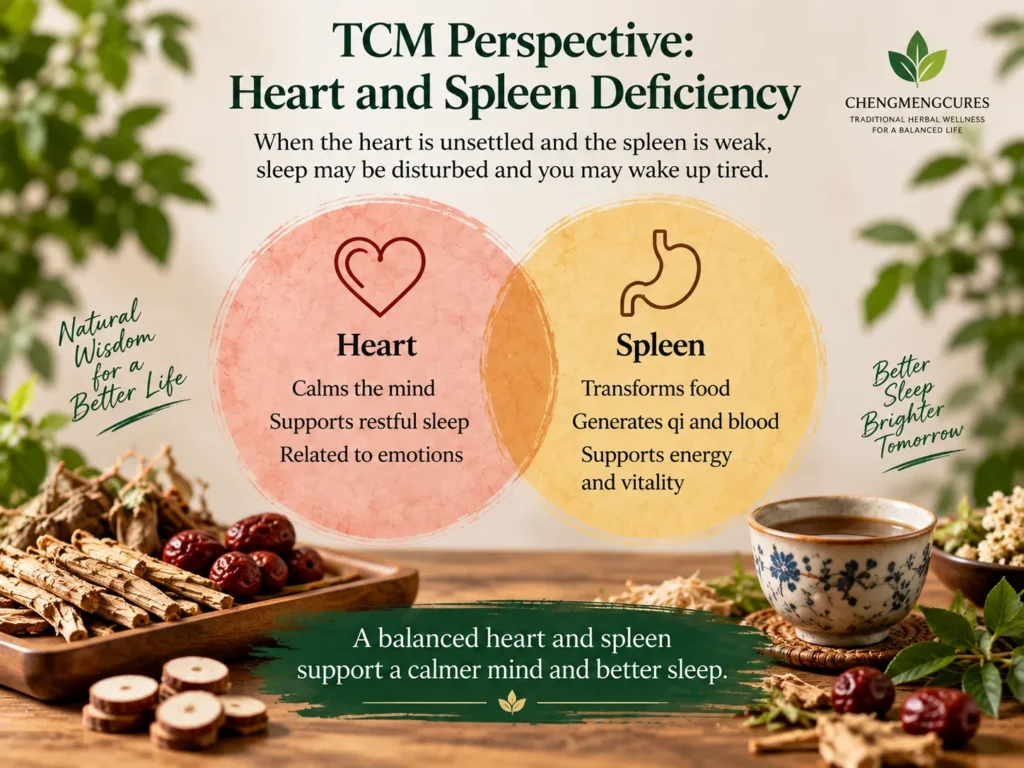
From a Traditional Chinese Medicine perspective, the video describes these signs as deficiency of the heart and spleen pattern, or xīn pí liǎng xū. In TCM, the Heart and Spleen are functional systems within a traditional framework. They are not direct references to heart disease or disease of the anatomical spleen.
The traditional explanation connects unsettled sleep and frequent dreaming with the TCM Heart system. The tired, unrefreshed feeling is discussed alongside weakness in the TCM Spleen system. The speaker therefore groups difficulty falling asleep, dream-disturbed sleep, easy waking, fatigue, and palpitations into one traditional pattern narrative. This is an interpretation used in TCM practice, not a test result and not a biomedical explanation of why the symptoms occur.
In that framework, “I dream too much and wake up tired” is treated as part of a broader pattern only after the person’s full presentation is considered.
The clip also says the problem should not automatically be dismissed as pressure or long-term anxiety. A safer reading is that symptoms alone cannot establish any single cause. If you wonder, “why am I still tired after sleeping,” a qualified clinician can help review sleep habits, medicines, mental health, breathing during sleep, and other possible contributors. A TCM practitioner may separately assess whether the traditional pattern description fits the individual presentation.
For broader evidence-based background, the U.S. National Center for Complementary and Integrative Health provides an overview of sleep disorders and complementary health approaches.
For another traditional framework associated with persistent tiredness, see our guide to qi deficiency tongue signs.
Traditional Herbal Approach
The speaker refers to a seven-ingredient traditional preparation intended, in TCM terms, to nourish the Heart, calm the spirit, support qi, and strengthen the Spleen. Those phrases describe traditional functions within the TCM framework; they do not establish that the preparation treats insomnia or palpitations in modern clinical terms.
Because the source does not name the seven ingredients, the formula cannot be presented responsibly here. There is no safe way to infer the herbs, their proportions, preparation method, dose, or suitability. Products that share a general purpose can contain different ingredients, and herbs may cause side effects or interact with medicines. Anyone considering a traditional formula should take the original source or product label to a qualified practitioner or pharmacist for review instead of buying several remedies at random.
This limitation is especially important when a person has persistent sleep disruption or palpitations. An educational article can explain the video’s traditional reasoning, but it cannot select a formula for an individual. The statement “I dream too much and wake up tired” is a useful description to bring to a consultation, not a diagnosis by itself.
Quick Question
Why do I dream too much and wake up tired?
If “I dream too much and wake up tired” describes your experience, possible contributors can include fragmented sleep, stress, medicines, breathing problems during sleep, or other health conditions. TCM offers a separate traditional framework, but persistent symptoms deserve assessment by a qualified health professional.
Final Note
TCM body patterns vary from person to person, and similar symptoms may have different causes. This article is for education about traditional herbal and wellness concepts and does not provide a medical diagnosis. Seek advice from a qualified health professional for symptoms that are persistent, severe, unexplained, or worsening, and obtain prompt care for palpitations with chest pain, fainting, or breathing difficulty.