
Introduction
Dryness can show up in more than one place. People searching for herbal tea for dry mouth may also notice a dry throat, irritated eyes, an itchy nose, cracked lips, or a dry tongue. One Traditional Chinese Medicine video connects these signs with different TCM functional systems and presents several herb combinations for traditional use.
This framework does not diagnose the cause of dryness, and the organ names used in TCM do not refer only to the anatomical organs. Persistent dry mouth, eye irritation, voice changes, mouth ulcers, or other unexplained symptoms deserve medical or dental assessment. The details below summarize the video for education and safer discussion with a qualified professional.
Common Signs You May Notice
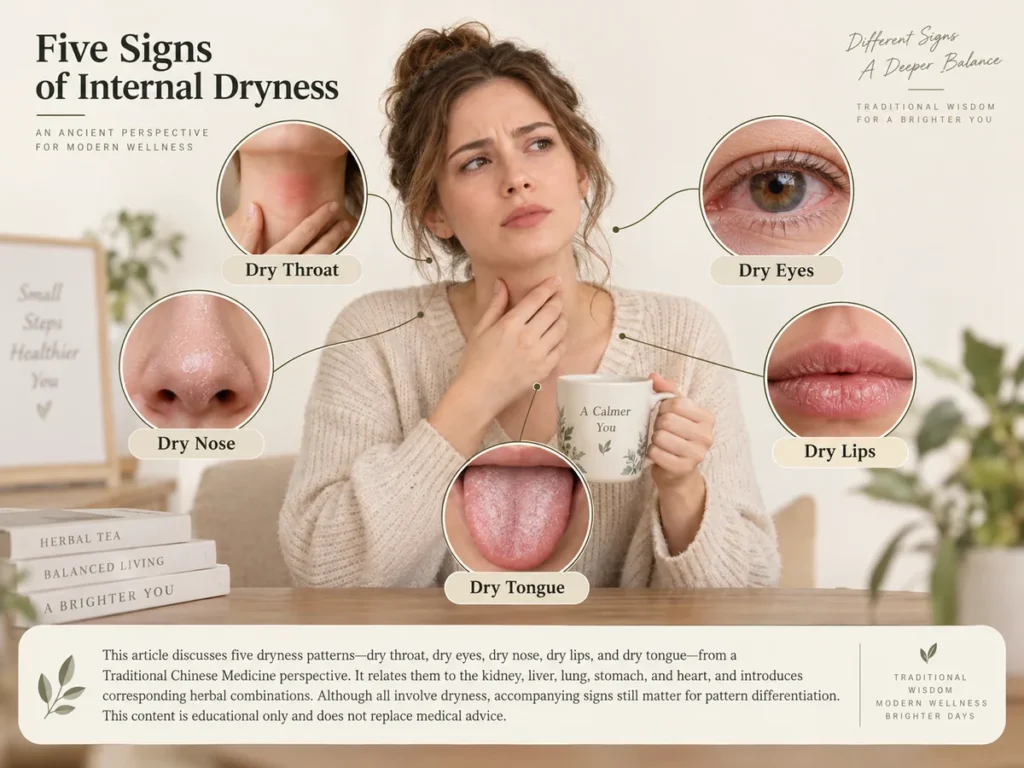
The video describes five groups of signs. A person does not need to have all of them, and each group may have causes outside the TCM framework.
- Dry throat: thirst or a parched throat accompanied by low-back or knee soreness, warm palms, hot flushes, or night sweats.
- Dry eyes: eye irritation or itching, blurred vision, or watering when exposed to wind.
- Dry nose and skin: an itchy, dry nose together with a dry cough, little phlegm, hoarseness, dry skin, or constipation.
- Dry or cracked lips: peeling lips with a dry or salty-tasting mouth, increased hunger, constipation, and a thin build.
- Dry tongue: a dry tongue or red tongue tip accompanied by restless sleep, frequent dreams, palpitations, yellow urine, or recurring mouth ulcers.
How TCM Traditionally Explains Herbal Tea for Dry Mouth
The video draws on the traditional idea that the five zang systems are associated with different body fluids. In this account, dryness in the throat is linked with Kidney yin deficiency, dry eyes with insufficient Liver blood or Liver yin, and dry nose with Lung yin deficiency. Dry lips are linked with Stomach yin deficiency, while a dry tongue is discussed through Heart blood, Heart yin, or Heart fire.
These are TCM pattern concepts, not biomedical diseases. The TCM Kidney, Liver, Lung, Stomach, and Heart are traditional functional systems and should not be read as proof that the matching anatomical organ is damaged. For example, Kidney yin deficiency pattern is a traditional description that can include dry mouth or throat, warm sensations, night sweats, and low-back soreness. It is not chronic kidney disease. Likewise, Lung yin deficiency pattern is not a diagnosis of lung infection or another respiratory disease.
Within that traditional framework, herbal tea for dry mouth is chosen by the wider pattern rather than by one symptom alone. The same dry feeling may be discussed differently when it appears with night sweats, eye discomfort, hoarseness, digestive signs, or restless sleep.
Traditional Herbal Approach
For readers considering herbal tea for dry mouth, the video gives five combinations. It describes them as traditional approaches to nourishing yin, supporting fluids, or calming the Heart-mind. It does not establish that they work for every cause of dryness.
- For a dry throat with Kidney yin signs: 15 g prepared rehmannia root, 10 g mulberry fruit, and 10 g glossy privet fruit simmered in water.
- For dry or irritated eyes: 10 g goji berries, 5 g chrysanthemum flower, and 9 g Chinese angelica root prepared together.
- For a dry nose, dry cough, or hoarse voice: 10 g glehnia root, 10 g ophiopogon root, and 15 g lily bulb simmered in water.
- For dry or cracked lips with Stomach yin signs: 9 g dendrobium stem, 10 g raw rehmannia root, and 15 g Chinese yam prepared in water.
- For a dry tongue with restless sleep or palpitations: 5 g salvia root, 3 g ginseng, and 10 g sour jujube seed.
These amounts reproduce the video; they are not a personal prescription. Several listed herbs may be unsuitable during pregnancy, with certain medical conditions, or alongside medicines. Ask a qualified clinician or licensed herbal professional to review the complete combination, product quality, and possible interactions before use. Plain water, prescribed care, or treatment of an underlying cause should not be replaced by an unreviewed herbal preparation.
Final Note
TCM patterns vary between individuals, and similar dryness can arise for different reasons. This article presents traditional herbal and wellness education from one video; it is not medical advice or a diagnosis. Seek a qualified medical or dental professional for dryness that is persistent, severe, worsening, or unexplained, or when it affects eating, swallowing, speaking, vision, breathing, or sleep.
Further Reading
Explore more traditional herbal wellness articles.